*notcot in design , 11:38

Deconstructing Lichtenstein- 10.23.07
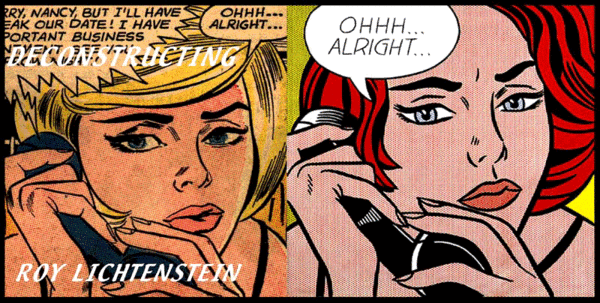
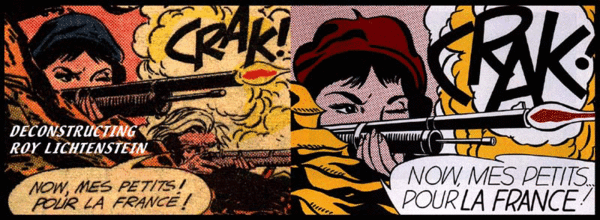
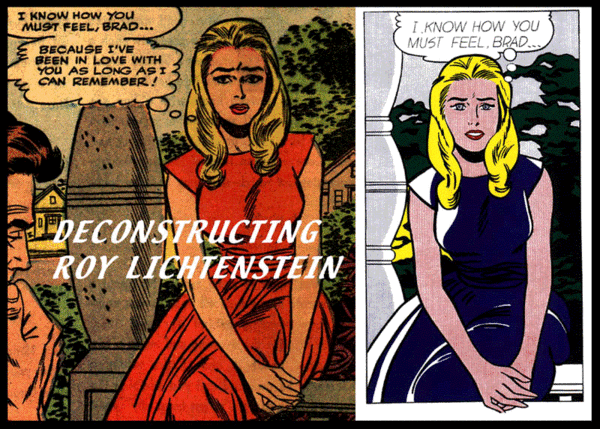
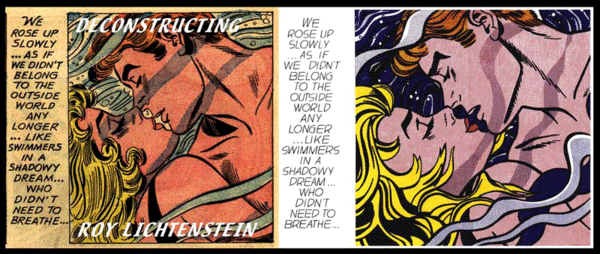
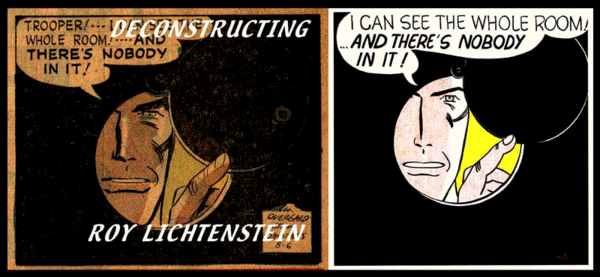
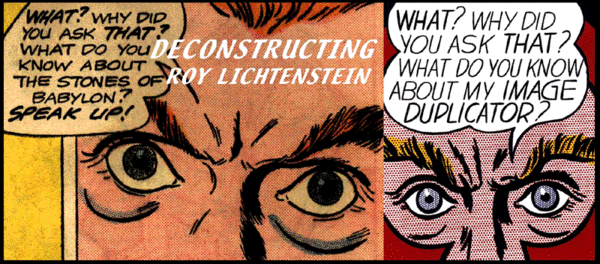
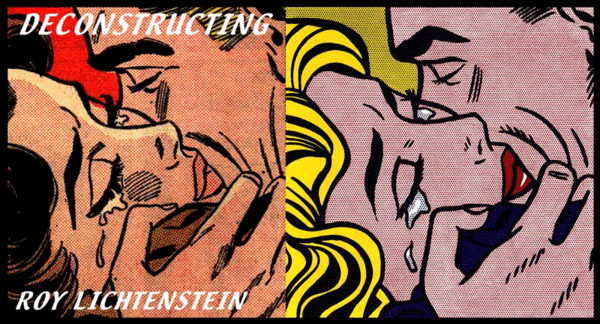
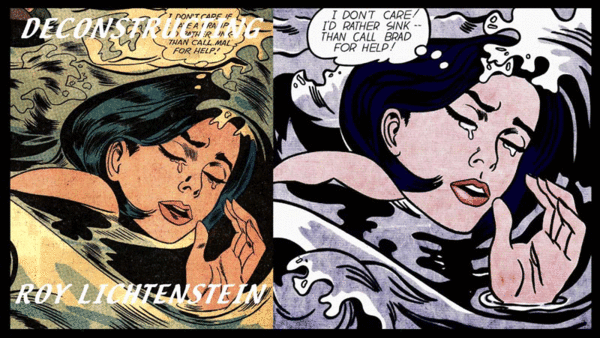
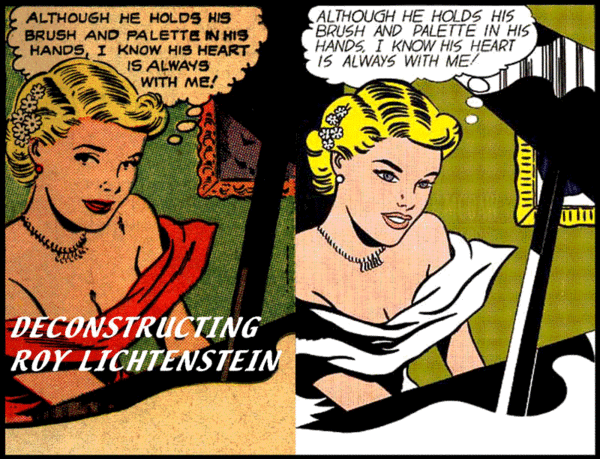
OH-ALRIGHT.gifWow. Apparently David Barsalou has spent the last 25 years of his life going through every illustration in over 30,000 comic books…. in order to find the original sources of Roy Lichtenstein’s pieces! Here are some of my favorites ~ more can be seen on David Barsalou’s Deconstructing Roy Lichtenstein page as well as his flickr. Noticed this over at Life Lounge.
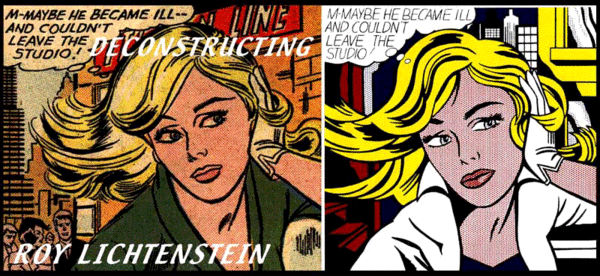
M-MAYBE.gif

PIANO-1.gif

CRAK.gif

FEEL-BRAD.gif

WE-ROSE.gif

THE-WHOLE-ROOM.gif

DUPLICATOR.gif

KISS-5.gif

DROWNING-.gif

Tags:

23 Notes

amazing

----- iris 24.10.07 03:38

Are these, then, all copyright violations?

----- Dan Lewis 24.10.07 07:36

The originals are better, IMO. The faces are more expressive and defined, proportions are better, and the lines convey more motion and energy.

----- David 24.10.07 07:43

They most certainly are not copyright violations. Lichtenstein went through 5 years of legal battles along with raushenburg, and warhol clearing up the difference between APPROPRIATION and FORGERY.

Any media taken out of its original context and put into another,,, such as a comic book to an enormous painting,,, becomes another piece.

Comic books were going for 5cents back then and his paintings were selling for millions. At first the comic book crowd were angry until they realized that Lichtenstien had made them famous and the illustrators took it as a compliment. Their is a large possibility that narrative illustration in general would not be where it is today without his help.

----- Neal 24.10.07 15:34

what an incredible document
it’s 1+1=3
the side by sides are more compelling than either alone

----- neene...random thoughts... 24.10.07 19:16

still doesn’t excuse the fact that he’s an unoriginal hack.

----- Michael 24.10.07 20:58

So many comic book artist die penniless and they were suppose to feel flattered that Roy Lichtenstein made so much money off of their work? That’s ridiculous.

----- Katie 27.10.07 12:31

Fascinating piece (not quite the right word) of research. I was assuming the original comic book illustrations were his work as well. Some of the commentary has confused me though; is the suggestion that he plagiarized another artist’s work?

----- Deb 27.10.07 16:57

If that is the case then every artist you have ever seen on any gallery wall is a fraud because EVERY single one has used appropriation to form their images. People have a common imagery that they use to identify things everyday, the original image that they saw isn’t “theirs” but they reproduce it in their mind.

Roy Lichtenstien only used work from his 3 favorite comic book artists and they did not die pennyless. The comic book industry in whole thanks artists like Roy and Andy Warhol for promoting what would normally be considered low art, up onto a museum wall. He brought the comic books back out of the ashes so that we could have things like DC and Marvel comic books.

Granted I might be a tad biased being an Art Historian/Artist, but if their is one thing I learned in my masters is not to try to box in artwork.

----- Neal 29.10.07 06:51

hi i don’t get which one is the original r.l painting??? really like his art work tho….

----- claire 26.11.07 23:19

Neal, the idea that Lichenstein is responsible for comic book art being properly recognised as a genuine art form is utterly ridiculous. Not only that, it’s an insult to the true masters of the form - people like Jack Kirby, who had more original talent in his little finger than Lichtenstein and Warhol put together. But instead of getting on your art historian high horse, why not look, again, at the pictures above - I mean, look with your eyes, not with your degree. If you look properly, fairly, you’ll see, as someone else has pointed out, that the original works are superior to Lichtenstein’s hack work.

Oh, and I’d suggest that you refrain form talking about comic books, its art and its history - it’s patently obvious that you know very little about it.

----- Paul 09.01.08 07:25

thats funny because Lichtenstien only used artwork from three comic book artists… none of which were your friend Kirby. All of those three artists greatly appreciated Lichtenstien for bringing their artwork into the high art realm. If you knew anything about comic books, then you would know that both Marvel and DC were both about to go bankrupt which would have affected all of their subsideraies. There comic books were going for about 10 cents a pop and the artists were barely making enough to get by. So theoretically, if it weren’t for these contemporary artists, you might not even have the comics which you think are so amazing. Pride has nothing to do with it, respect to an artist is en entirely different subject.

----- neal 16.02.08 16:56

I just copied a lichtenstein for my personal collection, and I felt bad… now I feel less bad.

John

----- John 25.02.08 13:31

wow i really like your pictures maybe you should start making some up yourself instead of copying i think your do wel :]

----- katie 24.03.08 03:16

Any of you complaining about his artwork obviously don’t know anything about the Pop Art movement.
It’s so sad that so many people are so CLOSED MINDED.

Get a book.
Look it up.

----- Cara 28.04.08 15:22

Thank you Paul, for taking anytime to try to inform these people. If they did pick up a book, they would realize that the importance of Lichtenstein’s work does not result from his person originality in style or form but from the fact that the images are copies. Copies taken from the highly consumed pulp fiction genre, that when seen seperatly from the rest of the original work (and yes comics are an art form), highlight the narrow parameters the characters acted under and the subtle yet profound restrictions of gender.

----- Justine 11.05.08 07:54

The people above are saying why should just one cartoonist be picked among the thousands? but if you think about it, it’s the same in almost all situations. As such with Madeline Mccan, she was one of the hundreds of missing children yet millions was spent on that one child, her case not much different to millions of others. Lichtenstein was simply chosen so don’t pull him down because he was selected and not everyone can be.

----- jasmine, 8 20.05.08 22:38

Im sorry Paul, but saying they appreciated Lichtenstein plagarism is a stretching it, please cite your sources for this claim since all prior experience with this topic has drawn up conversations with slightly bitter feeling from said artists. Also I believe he plagerised from more than three artists work. Russ Heath, Irv Novick, Tony Abruzzo, Jerry Grandinetti and George Tuska are 5 I can pull off the top of my head not to mention many more that have yet to be identified.

Truely it seems as though your bias is clouding your writing as it is seems to contain erroneous detail.

If you truly know the subject you are arguing check your facts.

As for Lichtenstein, whether you can argue the definition of plagarism and how it applies to him (I personally believe it does and he should have been accountable for it ),it still remains that from a moral stand point this was wrong in so many ways (even more so considering Irv Novick served with Lichtenstien and his theft is on a more personal level).


----- Sonya 22.05.08 06:28

last year i had to do a project on natural form and metamorephasis my final peace was of a naked woman and her hair terned in to tree branches and my friend coped it and every one thinks shes amazing at art so they always asked to look at her work so they all thought it was her idea when it was mine and i got no credit and it feel horrible but my teachers could do nothing about it because people use thing s for insperation all the time

i think that what Lichtenstein did was wrong because , like my friends, its a complete copy and even though the comic book writers were penny less they could of sold their paintings them selfs in stead of getting someone to basicly put his signature at the bottom of their ideas Lichtenstein might of helped start a movement but i don’t think that excuses him as the comic book writers could of just as easily and if people liked Lichtenstein work then surely they would of liked the work in the comic books

----- isabelle 03.06.08 12:23

The idea of copying something is what Pop Art was all about. Seeing one of these pieces in person also helps put things in perspective a bit. Andy Warhol copied a lot of stuff too, It all sort of fits within a specific part of Art History and was quite a radical shift back in the 1960’s.

----- Michael Caswell 02.07.08 21:33

why do you all have to carry on about it??? if it looks good then what is the problem?, i don’t see the point in wingeing about things that have already happened, we appreciate his talent and as long as he acknowledged the fact that he used another persons ideas then i don’t really see any problem at all, all art is just a copy of something else anyway…

----- ***RoBbO*** 03.08.08 20:48

Some of you people need to get a life. Roy Lichtenstein transformed a panel from a page in a comic book into a work of art in its own right. Sure, it was art before, but he is one of the primary people responsible for that style of art receiving recognition as real, respected art. He could just as easily have created these paintings without using the actual imagery from the comic books, but that was part of the point to his artwork, and it has nothing to do with stealing someone else’s work. If you cannot see that then you are missing the point. I’d love to stay and add more on this subject, but I’m not getting paid to educate anyone here, so you’re on your own.

----- Ed Smith 23.09.08 17:31

Pop Art is a movement that began in Germany in the 1950s, but had its most famous practitioners—at least in this country—in Andy Warhol and Roy Lichtenstein. Both used ads and comics for inspiration; the latter is most famous for his work mimicking comic books beginning in 1961. Of course, Bizet borrowed folk tunes in composing Carmen. Greek statues exist mainly because of Roman copies. Renaissance means “rebirth;” fifteenth century art and architecture copied from the past

Not all artists appreciated the fact that Lichtenstein copied their work, despite the fact that comic book artists had been doing it for years, the least talented ones lifting the work of better-paid strip artists like Milton Caniff, Alex Raymond and Hal Foster. (In the comic book world, copying another’s art was called either a “swipe” or an “homage,” depending on intent.) Comic book artists may have resented the fact that while they got $50 a page for their work, Lichtenstein was commanding gallery prices of $50,000 for his—and had the wherewithal to hire as many as five assistants at one time! Lichtenstein mostly abandoned comic books as a source for inspiration after 1964, but returned to comic motifs toward the end of his career in the 1990s. (I suspect this reflected the prices that “comic book” paintings commanded relative to other paintings he did during the interim.)

Warhol and Lichtenstein both saw the day when artists stole their styles back. Lichtenstein’s broad lines and “Ben Day” dots can be seen frequently in ads and on magazine covers today. In this case, art continues to imitate art.

----- Ed Smith 23.09.08 17:36

Leave a note

(Comments are manually approved before appearing above. Thanks for waiting!)


Design and Concept Copyright NOTCOT INC 2006-2008. Work in Progress - So be nice.